The foundation of a good golf swing lies in grasping four key elements: stance, alignment, grip, and posture. These components dictate how you control and maneuver your swing. A strong, balanced stance ensures stability, while proper alignment aims your shots accurately. Your grip is vital as it controls the club face, affecting the ball’s direction and distance. Lastly, maintaining good posture sets the stage for a fluid motion, crucial for a consistent swing.
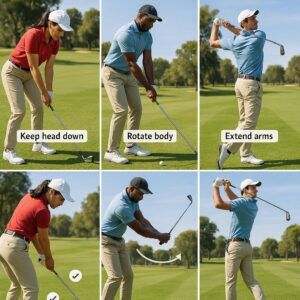
Balance and rhythm are the twin pillars of a great swing. Think of it as a dance—synchronized, smooth, and controlled. Having good balance means you’ll stay in control throughout your swing, preventing you from toppling over or losing form. Rhythm ties everything together, ensuring your swing is neither too fast nor too slow, providing optimal power and accuracy. Practicing drills that emphasize these aspects will improve golf swing techniques and your overall game.
Beginners often make a few common blunders, like gripping the club too tightly or standing too close to the ball. These mistakes can throw off your balance and lead to erratic shots. To counter this, try being more aware of your body’s mechanics. A softer grip and finding a comfortable distance from the ball can make a world of difference. And family or friends who play? They’re great resources for constructive feedback.
Beyond improving your game, practicing a balanced swing can have health benefits. Engaging various muscle groups promotes flexibility and strength, keeping you fit. Plus, the focus and discipline it instills can improve your concentration skills—something that’s useful off the course too. It’s more than just a game; it’s a holistic activity that benefits both body and mind.
Mastering the Art of the Backswing
Executing a perfect backswing starts with understanding its mechanics. Picture your goal as a smooth, controlled lift of the club, setting yourself up for an impactful downswing. The backswing shouldn’t be rushed; rather, focus on maintaining a steady flow. The idea is to create enough torque without losing control over your movements.
Flexibility and strength play a critical role in making a good backswing. Flexibility allows your shoulders and hips to rotate more freely, adding distance to your shot. Strength, particularly in your core and legs, supports stability and power through your backswing motion. Incorporate exercises like stretches and core drills into your routine to build these foundations.
Practicing targeted drills can significantly refine your backswing technique. Try consistent drills focused on shoulder rotation and wrist angles to integrate the key components of the backswing into your muscle memory. These exercises help in creating consistency and control, which translates to better overall performance on the course.
The impact of a solid backswing on your overall game can’t be overstated. It sets the stage for the rest of your swing, affecting how well you can follow through. A well-executed backswing ensures that you’re positioned correctly, allowing for maximum power and precision when you move into your downswing.
Techniques to Perfect Your Downswing
The downswing is where all the potential energy stored in the backswing is released. Breaking it down into clear components is essential. Start with your hips; they should lead the movement as you begin the downswing, creating a natural path for the club to follow. This motion helps maintain the correct swing plane, ensuring that the clubhead approaches the ball at the right angle.
Timing and tempo are your best friends during the downswing. It’s crucial not to rush this part of the swing. Allow the body’s natural momentum to guide the club, using a fluid and controlled motion. This timing ensures you don’t lose power or accuracy, which can often happen if you try to swing too hard or too fast. Practicing with a metronome or counting in your head can be good techniques to manage tempo.
Common downswing errors usually revolve around improper weight transfer and hand positioning. Shifting your weight forward too early can cause misaligned shots. Instead, ensure your weight moves gradually from your back to your front foot through the downswing. Similarly, focusing on your hand position, keeping them relaxed yet firm, prevents slicing or hooking the ball.
Modern technology provides some fantastic tools to analyze and refine your downswing. Devices like swing analyzers and video analysis apps offer insights that were once only available to the pros. They can highlight flaws and suggest corrections, enabling you to adjust your technique with precision. Embracing these tools can lead to more significant improvements in your game.
Enhancing Your Follow-through for Optimal Results
The importance of a good follow-through can’t be overstated. It reflects how well you’ve executed the whole swing, from start to finish. A balanced finish, with your body facing the target, is often a telltale sign of a successful strike.
Analyzing the connection between your follow-through and shot accuracy reveals some important insights. A complete follow-through ensures that energy is fully transferred from the clubhead to the ball, impacting both distance and direction. Pay attention to where your club points as it finishes, as it often correlates with where your ball will head.
To develop a consistent follow-through, incorporate practical drills into your practice routine. One simple drill is to hold your finish for a few seconds, checking your balance and club position. This holds you accountable and helps develop muscle memory.
Observing pro golfers is a great way to understand how effective follow-through looks in action. Players renowned for their technique, like Rory McIlroy or Nelly Korda, showcase excellent examples of how a dynamic follow-through enhances overall swing performance. Study their movements; you might pick up a trick or two to incorporate into your game.
The Speed Iron Will Help You Improve Golf Swing Techniques

One of the easiest ways for you to Improve Golf Swing Techniques is working out with a Speed Iron! The Speed Iron is a weighted golf swing training aid that will easily help you increase golf swing speed in just a few workouts!
The Speed Irons come in 2 different Models or Sizes and resemble a Driver and 6 Iron Golf Club.
- DRIVER: 45, 44 and 43 inch – Lengths and Weigh – 22, 24, 27 and 32 ounces.
- IRON: 37 and 38 inch – Lengths and Weigh – 20, 22, 26 and 32 ounces.
Check out more info. on the Speed Irons or you can buy a Speed Iron here Shop – Speed Irons.